Creative LED Display
Transparent, flexible, floor and stadium perimeter LED screens that break the rectangle.
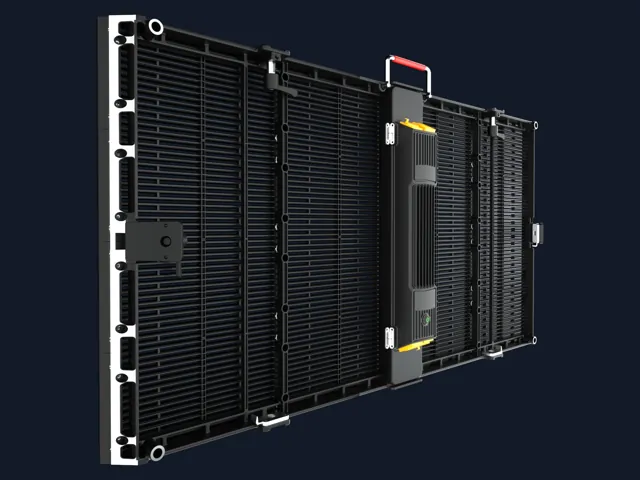
Transparent Series
70–85% transparency, IP65, 8kg glass-facade screen, P3.91
70–85% Transparent · IP65 · 8kg Lightweight View Details →
LED Dance Floor
2000kg/m² load-bearing interactive floor with GOB protection, P1.9–P3.91
2000kg/m² Load · GOB Protection · Interactive 128/256pt View Details →
F Series Flexible Module
Silicone soft modules that wrap columns down to 30.5cm diameter, P1.25–P2.5
Bends to ⌀30.5cm · Magnetic Mount · Silicone Body View Details →
Stadium Perimeter
Player-safe perimeter system with soft mask, 90–180° corners, IP65
Soft Mask · 90–180° Rotation · Emergency Exit View Details →How to choose creative LED displays
Creative LED displays solve spaces where a conventional flat rectangle is the wrong physical answer. Transparent screens preserve a view through glass, flexible modules wrap columns and arches, floor systems carry foot traffic, and stadium perimeter cabinets combine advertising visibility with pitch-side protection. Each format changes the mechanical problem more than the content problem.
The starting point should therefore be a drawing, photograph or short site video. Curvature radius, supporting surface, load, transparency target, weather exposure, audience position and maintenance route define what is possible. Our engineers map those constraints to a proven module and cabinet platform before finalising resolution or content dimensions.
Treat structure as part of the display
Flexible modules still need a precise magnetic or framed surface. Transparent cabinets need aligned hanging points. Floor panels need a level load-bearing base. Mechanical tolerances decide whether the finished image looks continuous.
Balance the special property
Higher transparency reduces LED density; tighter curves can restrict pitch and module size; higher floor loading adds structure. The correct product balances the defining feature with image quality rather than maximising one specification in isolation.
Prototype unusual geometry
For spheres, arches, columns and mixed surfaces, approve a cabinet drawing or sample section before mass production. This catches seams, content distortion, cable routing and service conflicts while they are still inexpensive to correct.
Approve geometry before mass production
Creative projects should move through drawing, sample and full-production gates. First confirm the active outline, module seams, minimum radius, support points and cable paths on a dimensioned drawing. Then build a sample section using the real surface or frame to review fit, content distortion, transparency or load behaviour. Only after approval should the full quantity be produced and calibrated. Keep a map of non-standard modules, spare shapes and installation sequence in the handover package; without it, replacing one custom section years later can become a new engineering project.
Other product lines
Get a factory-direct quote
Tell us your screen size, pixel pitch or application — an engineer replies with a detailed quotation within 12 hours on business days.