Double-Sided LED Displays for Shop Windows
For a shop window read from both the sidewalk and the sales floor, use one double-sided LED display rather than two screens back to back. Then specify each face separately. The street side needs 2,500–4,000 nits if daylight reaches the glass, while the store side is comfortable at 600–1,000 nits. Choose pitch from the closest regular viewer, and plan the air gap, power and service before the unit is hung.
What LED display works for a shop window seen from both sides?
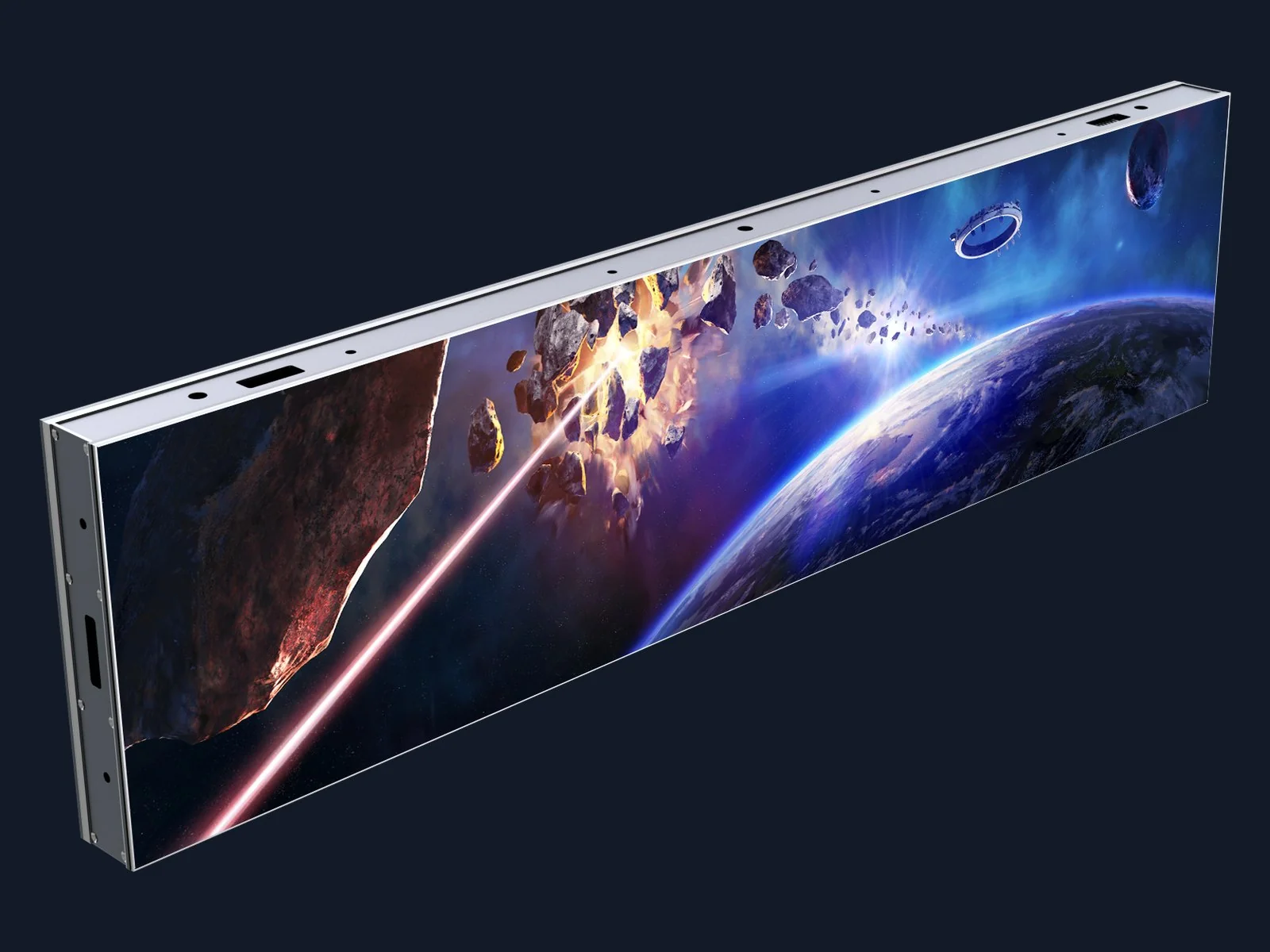
A double-sided LED display, with two display faces in one slim body, is the cleanest choice. It hangs in the glass line or stands on the floor and shows content to the street and to the store at the same time. Two single-sided screens mounted back to back double the depth, the cabling and the number of devices to manage.
- Hanging strips and banners: the MCVISUAL Double-Sided Series is 54 mm thick, with 250 mm tall panels in 500, 750 or 1,000 mm widths. The panels splice into long overhead runs.
- Floor-standing posters: the G-T5 double-sided poster is 750 × 2,000 mm and 54 mm thick, with Wi-Fi, LAN, HDMI and USB inputs and cloud scheduling for chains.
How bright does the street-facing side need to be?
A window display read from outside in daylight needs about 2,500–4,000 nits on the street-facing side. Direct sun on the glass, plus the reflection of the street, washes out anything dimmer. The store-facing side is indoors and is comfortable at 600–1,000 nits.
Be careful with catalogue figures here. The standard Double-Sided Series and G-T5 are rated at 600 nits (P1.25 and P1.5625), 800 nits (P1.95 and P2.5) and 1,000 nits (P3.91). That fits mall storefronts, covered arcades, shaded or north-facing windows, and the store side of any window. The G-T5 can be built with a different pitch and brightness on each face. For sun-exposed glass, ask for the street-side brightness in writing for your configuration, and judge a sample in the actual window at midday before ordering. The reasoning behind these ranges is in how many nits an LED display needs.
Which pixel pitch and how much resolution does a window display need?
Choose pitch from the closest regular viewer. The minimum comfortable distance in meters is roughly equal to the pitch in millimeters. A shopper standing at the glass, about 1–2 m (3–6 ft) away, needs P1.25 to P1.95. A sidewalk audience 3–5 m (10–16 ft) away is well served by P2.5 to P3.91.
Then check whether the resolution carries your content:
| Pitch | 1,000 × 250 mm strip | G-T5 face, 750 × 2,000 mm |
|---|---|---|
| P1.25 | 800 × 200 px | 600 × 1,600 px |
| P1.95 | 512 × 128 px | 384 × 1,024 px |
| P2.5 | 400 × 100 px | 300 × 800 px |
| P3.91 | 256 × 64 px | 192 × 512 px |
A 64-pixel-tall strip carries one line of large text or a logo. Product images and price lists need the finer pitches. The full method is in how to choose LED display pixel pitch.
Can each side show different content?
Yes. Double-Sided Series units can show the same content on both faces or run separate A and B content. A common setup is promotions to the street and wayfinding or prices to the store. Decide this before ordering, because it sets the controller configuration and the content workflow.
For a chain, check that both faces of every unit appear as separate, schedulable outputs in the content system. Check the user permissions too, so a store manager cannot overwrite the street-side campaign. G-series posters support synchronous and asynchronous playback, split-screen windows and cloud cluster management.
What about heat, power and mounting behind the glass?
Treat the window as an indoor location that gets hot. Double-Sided Series units are rated IP31, so they belong behind the glass, never outside it. Leave an air gap between the display and the glazing so sun-heated air can escape. The aluminum bodies are fanless and cool by conduction and convection, and that needs moving air around them.
Power is modest. Both products are specified at 650 W/m² maximum and 100–200 W/m² average. A 1,000 × 250 mm strip peaks at about 160 W and typically draws 25–50 W. A G-T5 face is 1.5 m² of display. Hanging runs need a ceiling fixing rated for the weight and a cable route planned before the window is dressed. A floor-standing G-T5 weighs 50.2 kg (about 111 lb), so check the floor of a raised window bed.
How is a double-sided window display serviced?
From the front of each face, without taking the unit down. Double-Sided Series modules attach to magnetic columns with hard-wired, cable-free connections, so a module lifts off and hot-swaps by hand. The G-T5 is also front-serviced. Keep a few same-batch spare modules per store or per region, so a replacement matches the colour of its neighbours.
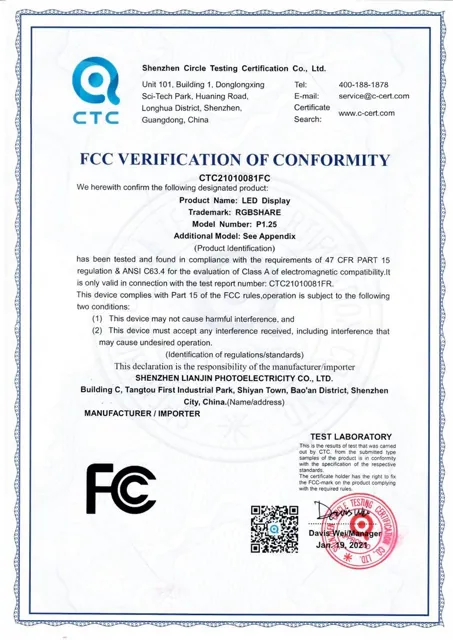
For plug-in retail units in the United States, confirm the input voltage and plug type, and ask which FCC and NRTL documents cover the finished product. The FCC, UL, ETL and NRTL document check explains what to verify. To get a quote, send the window size, the sun orientation, the viewing distance on each side, the content plan and the number of stores, using the U.S. LED wall project brief.