Front-Service Outdoor LED Cabinet Checklist
Front service only helps if every part that fails can be replaced from the viewing face without breaking the weather seal. Check which parts come out from the front, how the cabinet stays IP65 after a module swap, the depth and weight the structure must carry, the power to plan for, and the U.S. listing that applies to the finished sign. Then prove each point at the factory before the cabinets ship.
What should come out from the front of a front-service outdoor cabinet?
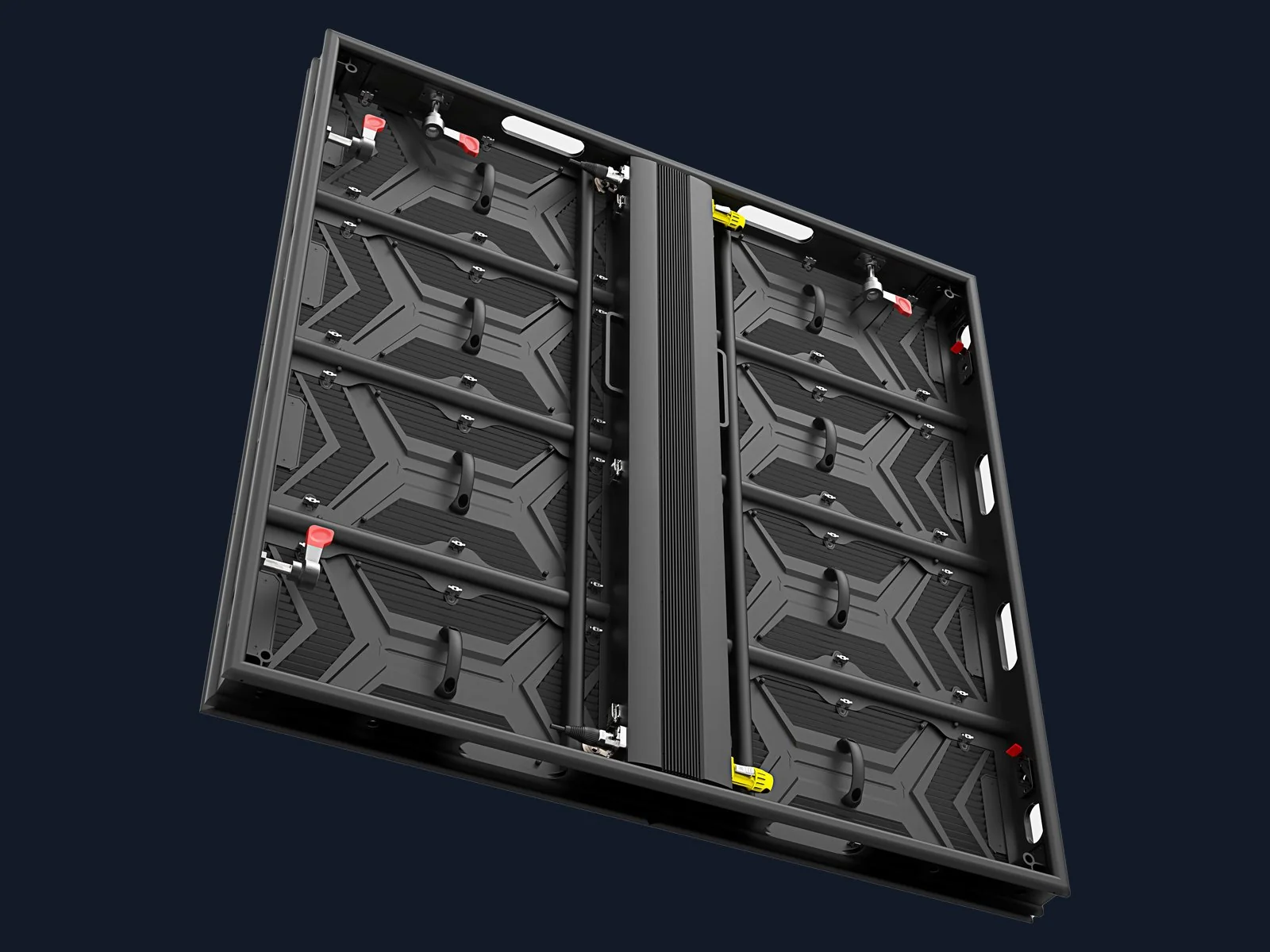
At minimum, LED modules must come out from the front. Ideally the power supplies and receiving card can be reached through the module opening too. Many cabinets sold as front-service only release modules from the front. The power supply or card then still needs rear access, which a wall-flush billboard does not have.
Ask the supplier to mark on the cabinet drawing which parts each access side reaches. The MCVISUAL Ti Series and ES Series are specified for front and rear maintenance, with hard-connected, hot-swappable modules. Hard-connected means the module plugs straight into the cabinet with no loose cables. Even so, confirm the power-supply and card access path for the exact configuration you are quoting, not for the product family in general.
- Which tool releases a module, and does the crew need to carry it to every site?
- Can a module be swapped with the screen powered on, and does the content keep running on the other modules?
- Are the power supply and receiving card reachable from the front, and in how many steps?
Does the cabinet stay IP65 after a module is removed and refitted?
It should, but only if the seal is part of the module or the cabinet frame, not a one-time sealant applied at the factory. Ti and ES cabinets are rated IP65 on both the front and the back, with a fanless design, so there are no filters or fans to maintain.
Ask what makes the seal at each module edge, and whether that seal is reused or replaced after a swap. Ask for the IP test scope, too: which face, which test standard, and whether the sample was tested after the modules had been removed and refitted. On salt-air or coastal sites, also check connector entries and seams. The Jeju outdoor P4 project was specified with sealed cabinets and protected connector entries for exactly that reason.
How deep and heavy are the cabinets, and what does the structure carry?
Plan the steel structure from cabinet weight per square foot and from the cabinet depth. Front service is what allows a wall-flush install without a rear catwalk. Use the quoted data, not brochure averages:
| Cabinet | Size | Weight | Load |
|---|---|---|---|
| Ti Series | 37.8 × 37.8 in (960 × 960 mm) | 49.6 lb (22.5 kg) | 5.0 lb/ft² |
| ES 800 × 900 | 31.5 × 35.4 in | 38.6 lb (17.5 kg) | 5.0 lb/ft² |
| ES 800 × 1200 | 31.5 × 47.2 in | 49.6 lb (22.5 kg) | 4.8 lb/ft² |
The Ti cabinet is 83 mm (3.3 in) deep. Ask for the ES depth on the drawing for your configuration.
A 6 × 4 array of Ti cabinets is 5.76 × 3.84 m (about 18.9 × 12.6 ft). The 24 cabinets weigh 540 kg (about 1,190 lb), before steel, cladding and cabling. Wind load, the structure and the sign permit sit with a licensed engineer and the local jurisdiction. The factory supplies the cabinet weights, fixing points and drawings that engineer needs.
How much power should the circuits and running cost be planned for?
Size the circuits from the maximum figure and budget the electricity from the average. The Ti Series is specified at 800 W/m² maximum (about 74 W/ft²). Its average is 200–300 W/m² at P4 and 100–200 W/m² at P5 to P10, or about 9–28 W/ft². The ES Series is 780 W/m² maximum and 200–300 W/m² average.
For the 6 × 4 Ti example above (22.1 m², about 238 ft²), the peak is about 17.7 kW and the typical draw is about 2.2–6.6 kW. That gap is why an ambient-light sensor matters: the screen runs bright at noon and dims after dark. The 350 m² P5 tower facade on the Ti platform drops its night level automatically for that reason. Circuit design and conductor sizing follow the NEC and the local electrical inspector, using the quoted per-cabinet figures.
Which brightness and pixel pitch fit the site?
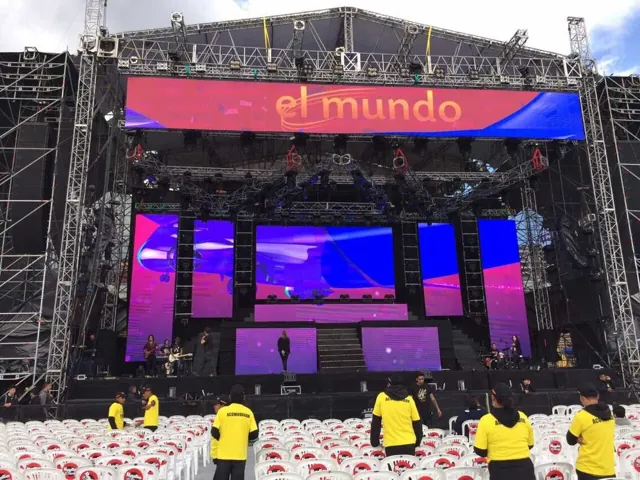
Choose brightness by sun exposure, then choose pitch by the nearest regular viewer. Shaded or north-facing outdoor screens need about 4,000–5,000 nits. Full-sun, south-facing screens need 5,000–6,500 nits. Sites near reflective glass, water or snow need 6,500 nits or more. The full table is in how many nits an outdoor LED display needs.
- Ti Series: ≥4,500 nits, P4 to P10, viewing distance 3–200 m depending on pitch. Suits shaded, east- or north-facing faces and energy-sensitive 24/7 media.
- ES Series: 6,500 nits from P4.16 to P10 (5,000 nits at P3.125). Suits full-sun faces, roadside billboards and sites read at highway distance.
Both run at 3,840 Hz refresh and 16-bit grey scale, which keeps the screen clean on phone cameras.
Which U.S. listing and FCC documents apply to an outdoor LED sign?
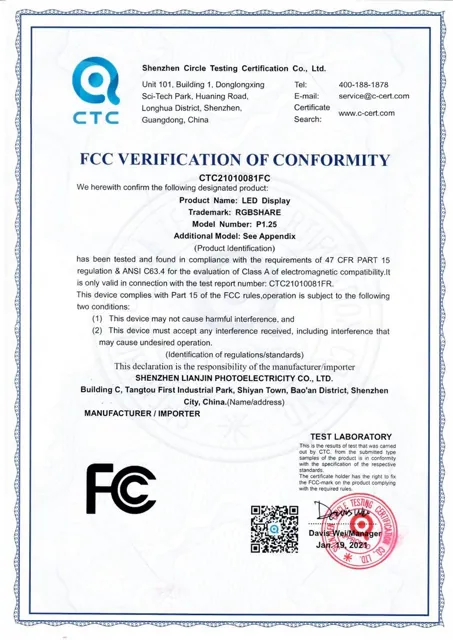
Outdoor electric signs in the United States are commonly evaluated to UL 48, the standard for electric signs. A field or factory listing by an NRTL is often what the inspector asks for. The display electronics also fall under FCC Part 15 for unintentional radiators. Which documents your project needs depends on the finished sign, the jurisdiction and who builds the final assembly, so settle this before the order, not at inspection.
Ask for each certificate's number, issuing body, holder and the exact model it covers, and check it against the quoted configuration. MCVISUAL shows each certificate's holder on the About page as issued and does not relabel it. The FCC, UL, ETL and NRTL document check walks through what to verify.
What should be tested at the factory before the cabinets ship?
Test the service process, not only the picture. During the factory acceptance test, ask the crew to remove and refit one module from the front with the tool that will ship with the order, and time it. Ask them to reach a power supply and a receiving card through the access path the drawing shows. Then check the seal and flatness after refitting. ES cabinets are specified at ≤0.1 mm flatness.
Add uniform colour fields, low-grey content, a brightness reading and the aging record to the same report. The LED display factory acceptance test checklist covers the rest. For quoting, send the site photos, the face's sun orientation, the mounting condition, the viewing distance and the power available, using the U.S. LED wall project brief.
Official references
- UL 48 — Standard for Electric Signs (UL Standards & Engagement)
- OSHA — Nationally Recognized Testing Laboratory Program
- FCC — Equipment Authorization